Product discovery is no longer a matter of better images, clever copy, or ranking for a few high-volume keywords. Shopping-related searches on generative AI platforms grew 4,700% between July 2024 and July 2025, and 39% of shoppers, 54% of Gen Z already use AI for product discovery. Increasingly, discovery is being delegated to systems that don't browse, skim, or "get the gist." They interpret, score, and decide.
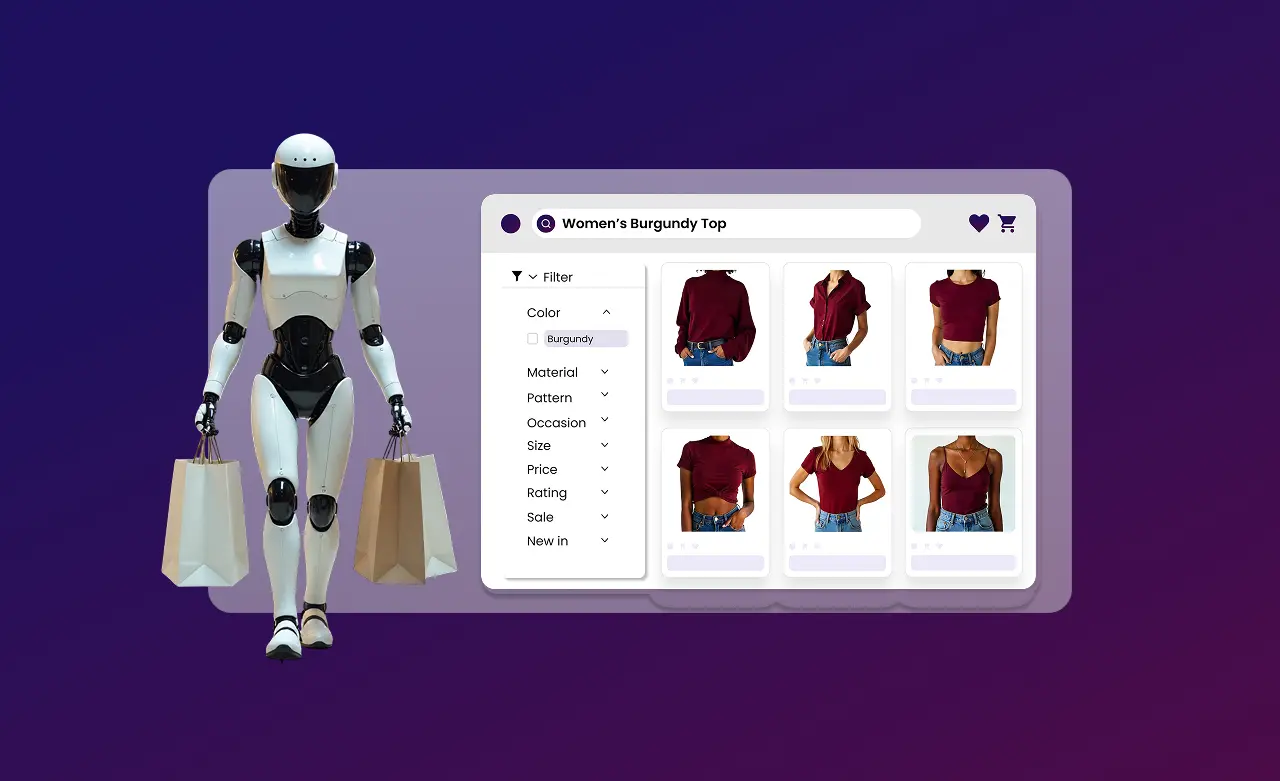
Today, AI shopping agents determine which products are shown, compared, recommended, or quietly ignored. And as this shift accelerates, one reality is becoming impossible to ignore: most product catalogs are failing, not because the products are bad, but because the data describing them is unreadable to machines.
This is the uncomfortable foundation of modern AI product discovery.
Discovery is no longer visual - it’s interpretive
For years, eCommerce was designed around human behavior. Shoppers would scan images, read descriptions, and infer meaning. Catalogs reflected that assumption: long-form text, loose terminology, and inconsistent attribute usage were considered “good enough.”
Machines work differently.
They don’t infer. They don’t assume. They ingest information at scale, normalize it, and make decisions in milliseconds. For that to happen, products must be described using machine-readable product data that removes ambiguity and leaves no room for interpretation.
When key information is missing, contradictory, or buried in prose, systems don’t “try harder.” They simply move on.
Why most catalogs fail by default
The majority of product catalogs were built for internal operations or basic storefront display, not for automated reasoning.
Typical failure points include:
- Inconsistent naming across similar products
- Missing or optional attributes treated as non-essential
- Descriptions that mix marketing language with technical facts
- Critical details hidden inside unstructured text
Without structured product content, automated systems cannot reliably compare products across brands, categories, or use cases. Comparison breaks down. Confidence drops. Visibility disappears.
Many catalogs rely on vague or brand-specific terminology. A “summer dress” or a “professional camera” may be clear to a human, but to a system, these labels are meaningless without defined parameters.
Data isn’t enough - meaning determines outcomes
Structure alone does not guarantee understanding. What matters is whether systems can interpret what a product is, who it’s for, and when it’s relevant.
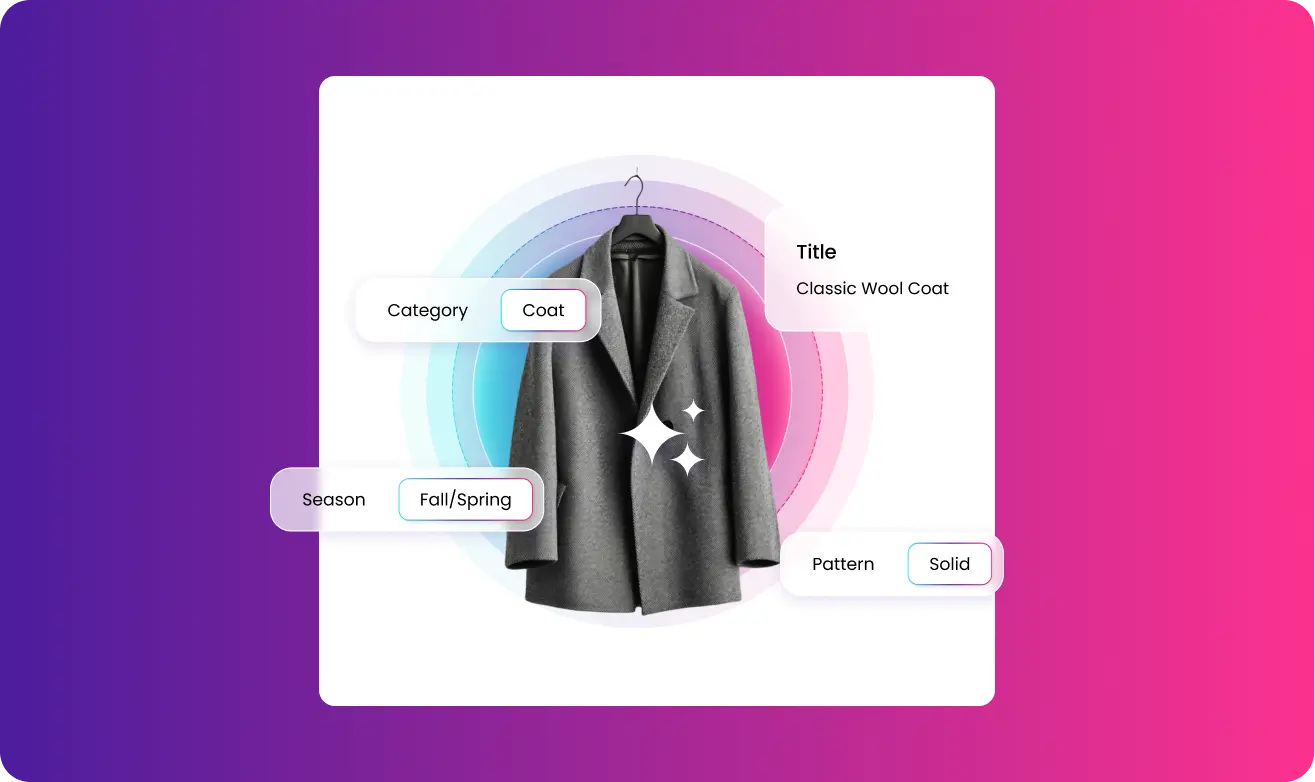
That requires explicit, contextual signals: size, material, performance range, compatibility, environment, and use case. These semantic product attributes allow systems to match products to intent rather than surface-level keywords.
Consider two jackets labeled “outdoor.” Without temperature ratings, insulation type, or weather resistance, a system cannot determine suitability. One product will be surfaced incorrectly, or not at all. This is how catalogs fail silently.
How products are actually judged
How AI shopping agents evaluate products
Automated systems assess products based on clarity, completeness, internal consistency, and comparability. They look for signals that a product fits cleanly into a category, satisfies a defined need, and can be evaluated alongside alternatives.
Signals are aggregated across data sources. Confidence compounds—or collapses.
When catalogs contain gaps or contradictions, uncertainty is introduced. And uncertainty has consequences: products are ranked lower, excluded from recommendations, or never considered. This is why visibility now depends less on merchandising tactics and more on AI commerce optimization.
Discovery now happens everywhere - and nowhere
Product visibility is no longer limited to search results. Discovery occurs inside AI assistants, recommendation engines, marketplaces, and conversational interfaces, often before a shopper expresses intent.
To optimize product catalogs for AI discovery, brands must stop thinking in terms of pages and start thinking in terms of structured product data for SEO and AEO. Every attribute, description, and tag must be machine-readable, consistent, and semantically meaningful.
3 Things Retailers Must Know as Shopping Becomes Agent-Driven
1. You are no longer selling only to humans
Purchasing decisions are increasingly influenced-or entirely made-by software agents optimizing for relevance, fit, and confidence. If your product information cannot be interpreted clearly by these systems, it may never reach the final consideration set.
2. Incomplete data equals lost trust
Agentic systems penalize uncertainty. Missing details, conflicting information, or vague claims reduce the likelihood of selection. Precision and consistency are now competitive advantages, not operational nice-to-haves.
3. Discovery happens before intent is visible
Unlike traditional funnels, agent-driven shopping often surfaces products before a shopper explicitly searches. Your catalog must be continuously “ready,” not optimized only around known keywords or campaigns.
Turning catalogs into discovery assets
Fixing these issues doesn’t mean rewriting everything manually. It means rethinking product content as a discovery layer, not just a description.
The impact is clear. Thrifted, for example, leveraged Pixyle.ai to optimize its product catalogs and achieved 10x growth in eBay revenue, rising from 2.5% to 20%, along with a 100% efficiency boost, increasing listing speed from 60 to 120 products per hour.
This is exactly the problem Pixyle.ai is built to solve. As a platform for Search-Optimised Product Content for Better Discovery, Pixyle.ai automatically generates optimized descriptions, tags, attributes, and FAQs directly from product images, making it easier for shoppers, search engines, and AI systems to find and understand your products, while saving teams time and increasing visibility where it matters most.
Discover Pixyle Ultimate Dress type Taxonomy Guide
Learn how to structure your catalog in a way that matches how people actually shop.


Boost your sales with AI product tagging
Optimize your eCommerce catalog to improve discovery and conversions.

.webp)