Product discovery is now decided by machines, not humans
Product discovery is no longer shaped by better imagery, stronger copy, or ranking for a set of keywords. It is increasingly determined by how clearly products can be interpreted by machines.
Consumers no longer search in simple fragments like “black dress” or “men’s trainers.” They ask contextual, intent-driven questions such as what to wear for a wedding under a specific budget or which jackets perform in wet winter conditions.
These queries are not handled through keyword matching. They are interpreted by AI systems that evaluate structured product data, attributes, taxonomy, and explicit product facts, to determine what is relevant, comparable, and recommendable.
This introduces a fundamental shift in commerce visibility: if product data is unclear, incomplete, or inconsistent, products are not just harder to find, they are effectively invisible.
Most product data was never built for this environment
The majority of product data in fashion retail was designed for operational use and human browsing, not machine interpretation.
It is typically created manually, often across multiple teams and systems, which leads to inconsistent attribute naming, fragmented data structures, and varying levels of detail across product types. Key information is frequently buried in unstructured descriptions or lost between systems such as PIMs, ERPs, DAMs, and eCommerce platforms.
At scale, this creates structural breakdown. Products that should be comparable are described differently. Attributes like material, fit, or occasion are missing or inconsistently defined. Taxonomy becomes fragmented, filters break, and search relevance degrades.
Traditional systems store product data. They do not interpret it. And in an environment where AI systems are responsible for discovery, that gap becomes critical.
From visual input to structured product intelligence
Extracted attributes only become valuable when they are standardised.
Once identified, product data is normalised into consistent taxonomies and aligned attribute frameworks. Variations in terminology are resolved, and products are described using a unified structure that removes ambiguity.
This creates a machine-readable layer of product intelligence where items can be reliably compared, filtered, and interpreted across systems.
At this point, product data is no longer a collection of disconnected fields. It becomes a coherent dataset that supports both operational systems and discovery systems.
Content becomes a by-product of structured data
When product data is properly structured, content is no longer created independently, it is generated from the underlying attributes.
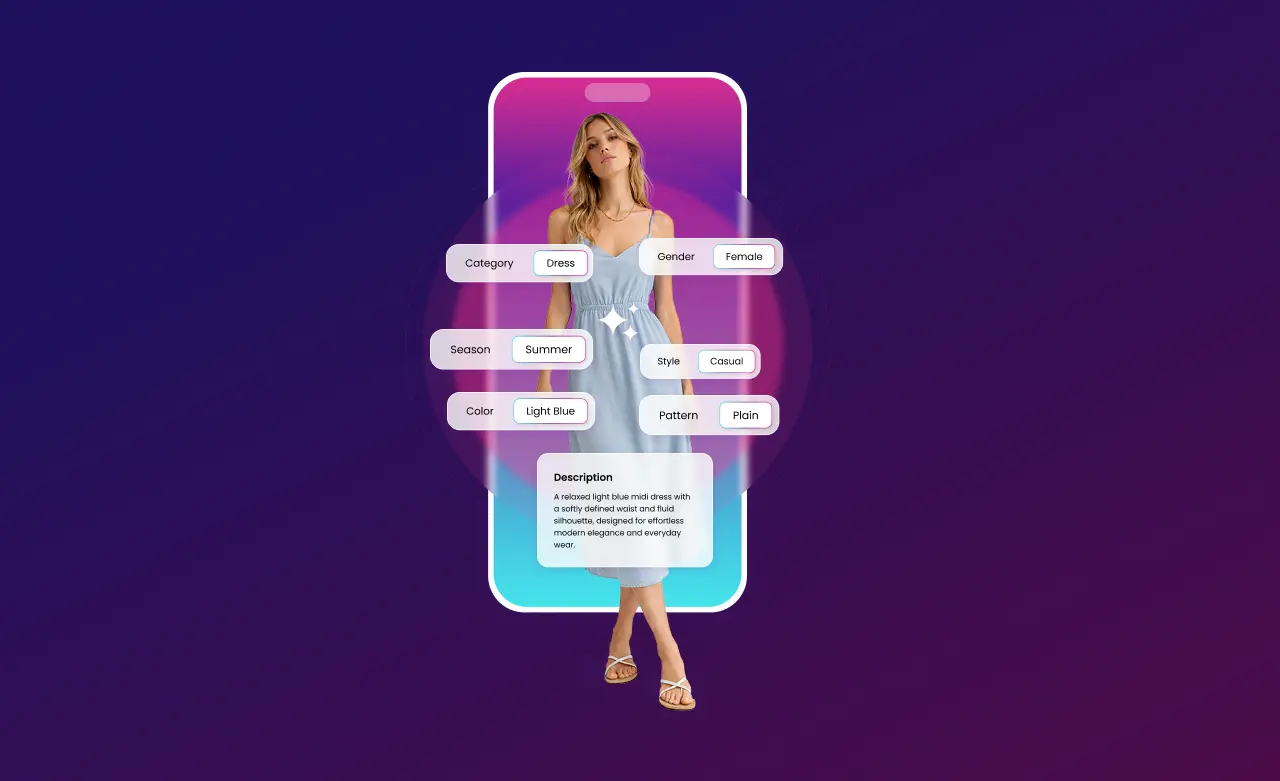
Product titles become precise reflections of product characteristics. Descriptions are grounded in factual attributes such as material, fit, and use case rather than generic marketing language. ALT text becomes consistent, accurate, and scalable, improving both accessibility and machine understanding.
This structure also enables more reliable FAQs and metadata generation, ensuring that product information aligns with how users and AI systems actually search.
The result is not just better content, but content that is inherently aligned with machine-readable product intelligence.
Discovery now depends on structured meaning, not keywords
Search engines and AI systems no longer evaluate products based solely on keyword relevance. They assess structured meaning.
This is where Generative Engine Optimization (GEO) becomes critical. AI systems rely on explicit product attributes to determine whether an item matches a query, particularly in conversational or intent-driven search environments.
Whether a product appears in AI assistants, recommendation systems, or emerging agent-driven shopping experiences depends on whether its data clearly expresses:
- What it is
- What it is made of
- When and where it is relevant
- How it should be used
Without this clarity, products are excluded from consideration.
Structured product data determines visibility across every channel
When product data is consistent and machine-readable, its impact extends across the entire commerce ecosystem.
Onsite search becomes more accurate because attributes are complete and comparable. Filtering becomes more reliable because taxonomy is consistent. Product comparison becomes meaningful because items share a standardised structure.
AI systems benefit most of all. They can evaluate products with higher confidence, match them to complex queries, and surface them in recommendations with greater accuracy.
In this environment, product data is no longer descriptive. It becomes the mechanism that determines visibility.
Why visual product data intelligence is becoming essential
As AI-driven discovery becomes more embedded in commerce, the expectations for product data are rising sharply.
Systems now require structured, explicit, and consistent inputs to operate effectively. Any ambiguity reduces confidence, and reduced confidence leads directly to lower visibility.
This is particularly relevant for fashion retailers, where product complexity, seasonal change, and large assortments make manual data management increasingly unsustainable.
Visual product data intelligence introduces a scalable way to resolve this by transforming images into structured product understanding and ensuring consistency across every downstream system.
Why Pixyle.ai matters
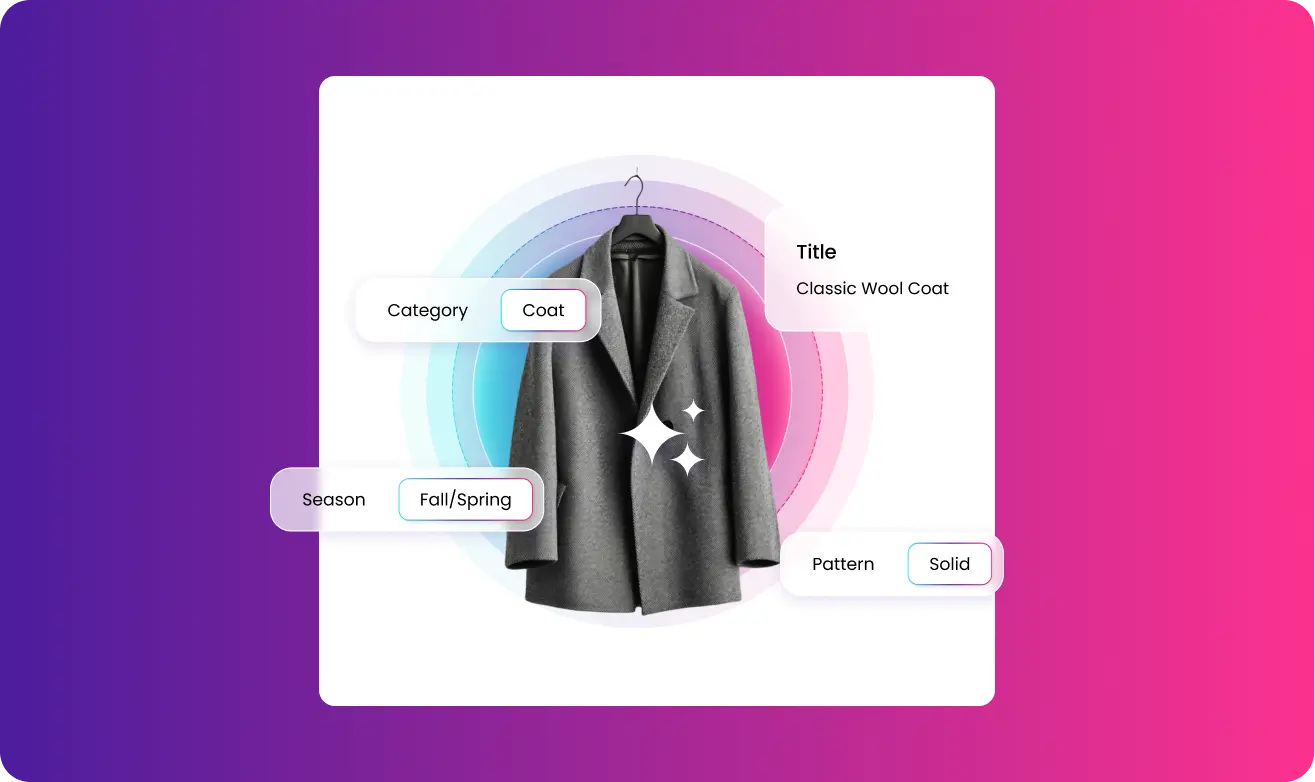
Visual product data intelligence turns product images into structured, machine-readable data that AI systems can actually understand and use.
In today’s commerce environment, product data is no longer just operational—it determines visibility. If it is incomplete or inconsistent, products fail to appear in search, recommendations, and AI-driven discovery.
As AI systems increasingly decide what gets surfaced and purchased, they rely on clear, structured product attributes rather than unstructured descriptions or visual assumptions.
Pixyle.ai is built for this shift.
Pixyle.ai is a visual product data intelligence platform for fashion retailers that transforms product images and existing inputs into structured, AI-ready product data. It powers search, filtering, SEO, GEO, and AI-driven discovery by creating a consistent layer of product intelligence across systems.
Instead of fragmented, manual data creation, Pixyle.ai extracts product truth directly from images and standardises it into machine-readable attributes that downstream systems can reliably interpret.
This ensures products are not just stored in systems, but understood, surfaced, and selected in AI-driven commerce.
Discover Pixyle Ultimate Dress type Taxonomy Guide
Learn how to structure your catalog in a way that matches how people actually shop.


Boost your sales with AI product tagging
Optimize your eCommerce catalog to improve discovery and conversions.

.webp)