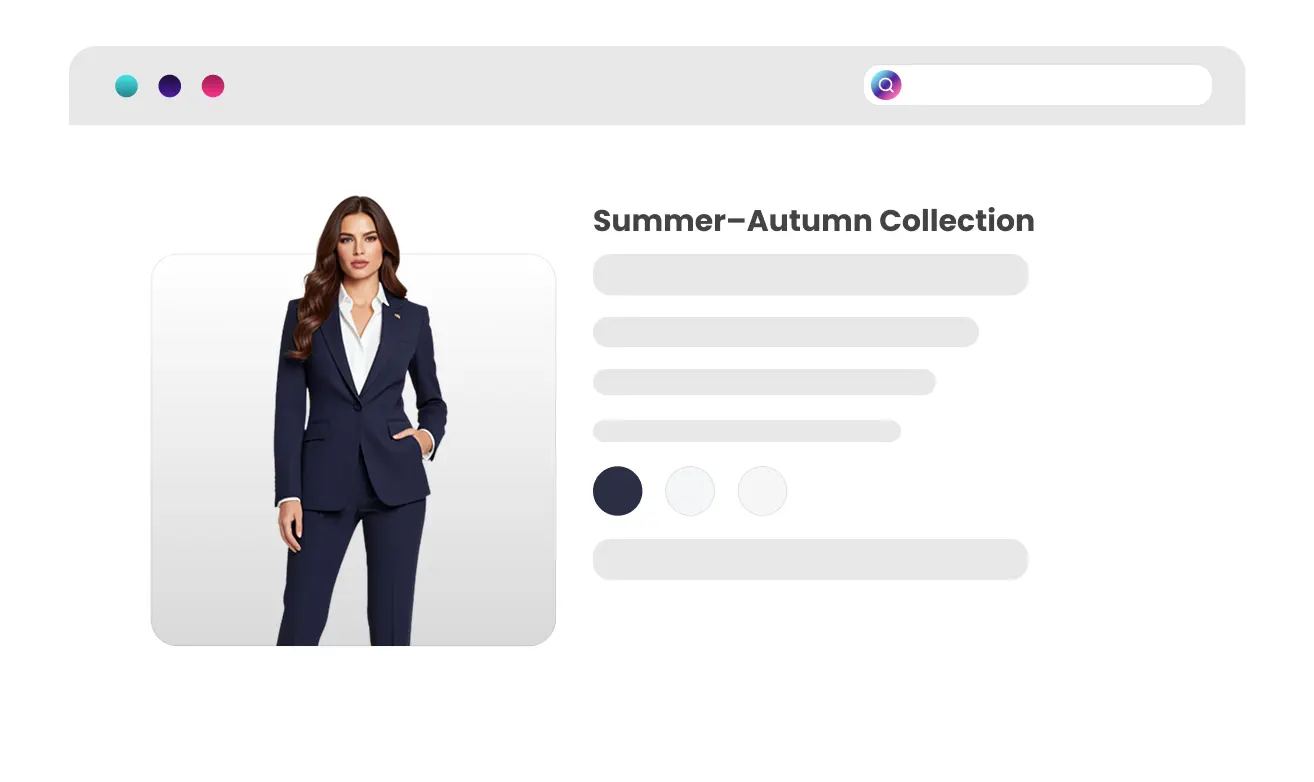
How AI Extracts Fashion Attributes from Images: A Technical Deep-Dive

Product Data Is the New Storefront
Fashion eCommerce is entering a new era.
For the past two decades, digital commerce has largely been designed around human behavior. Brands invested heavily in beautiful storefronts, compelling imagery, persuasive product descriptions, and merchandising strategies designed to influence human shoppers.
That model is beginning to change.
Today, product discovery is increasingly mediated by machines. AI-powered search engines, recommendation systems, conversational shopping experiences, and autonomous shopping agents are becoming part of the customer journey. These systems do not browse websites the way people do. They do not appreciate creative storytelling, lifestyle photography, or brand aesthetics in the same way a human shopper does.
Machines make decisions based on structured information.
As a result, a new reality is emerging across retail: product data is becoming the new storefront.
The quality of a retailer's product data increasingly determines whether products can be discovered, understood, recommended, compared, and ultimately purchased in AI-driven environments.
This creates a significant challenge for fashion brands and retailers.
Most fashion catalogs still contain incomplete attributes, inconsistent naming conventions, missing metadata, and supplier information that varies dramatically across products and channels. While these issues have always affected search and merchandising performance, they become far more problematic when AI systems are involved.
Machines cannot understand products that are poorly described.
This is where fashion attribute extraction becomes critically important.
Modern AI systems can now analyse product images and transform visual information into structured, machine-readable product intelligence. What was once a manual merchandising task is becoming an automated intelligence layer capable of powering the next generation of commerce.
Why Fashion Has a Product Data Problem
Fashion has always been one of the most data-intensive sectors in eCommerce.
A single garment contains dozens of potential attributes. A dress is not simply a dress. It has a category, colour, pattern, silhouette, material composition, neckline, sleeve construction, length, fit, occasion, style aesthetic, and countless other characteristics that influence how customers discover and evaluate it.
Traditionally, much of this information has been created manually.
Merchandising teams review products, write descriptions, assign categories, and add attributes to product catalogs. Supplier feeds contribute additional information, although data quality often varies significantly between vendors.
As catalogs expand across marketplaces, regions, and channels, maintaining consistency becomes increasingly difficult. Different suppliers may use different terminology for the same product. One seller may describe an item as a sneaker, another as a trainer, and another as a running shoe. Similar garments may be categorised differently across systems, creating fragmentation throughout the catalog.
The result is product data that is often incomplete, inconsistent, and difficult to scale.
This has direct consequences for discovery. Search engines struggle to match products with shopper intent. Filters become unreliable. Recommendation engines lack sufficient context to understand relationships between products. Marketplace visibility suffers. Accessibility initiatives become harder to implement. AI systems receive conflicting signals about the same item.
The challenge is no longer simply operational efficiency. It is becoming a competitive advantage.
Why Traditional Product Data Creation No Longer Scales
For many retailers, product enrichment remains heavily dependent on manual workflows.
This approach may work for a few hundred products. It becomes significantly more difficult when organisations manage tens of thousands or millions of SKUs across multiple channels.
Fashion commerce is moving faster than traditional enrichment processes can support. New products launch continuously. Marketplaces onboard sellers at unprecedented scale. Consumer expectations around discovery and personalisation continue to increase.
At the same time, AI-driven commerce introduces new requirements.
Retailers no longer need product data solely for eCommerce websites. The same information must now support search engines, recommendation systems, marketplaces, accessibility initiatives, generative AI applications, conversational commerce experiences, and emerging shopping agents.
The amount of structured information required per product continues to grow.
Manual enrichment cannot keep pace with these demands.
Retailers need systems capable of generating product understanding automatically and consistently at scale. This is precisely where AI becomes valuable.
How AI Sees a Fashion Product
When humans look at a garment, we instantly recognise hundreds of visual signals without consciously thinking about them. We identify colours, shapes, materials, silhouettes, patterns, and stylistic cues almost immediately.
Modern AI systems attempt to replicate this process.
Using advanced computer vision models, AI analyses product imagery to identify meaningful visual characteristics. Rather than treating an image as a collection of pixels, the system learns to recognize patterns that correspond to real-world product attributes.
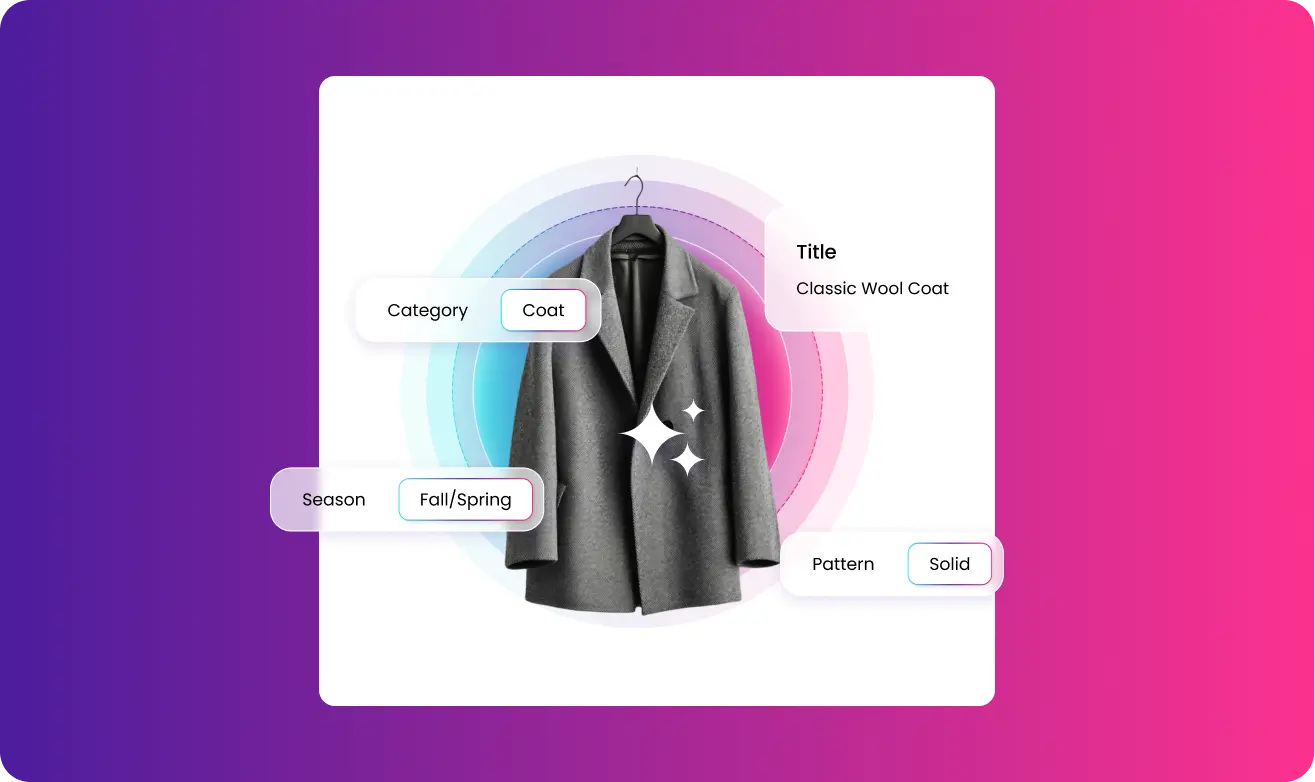
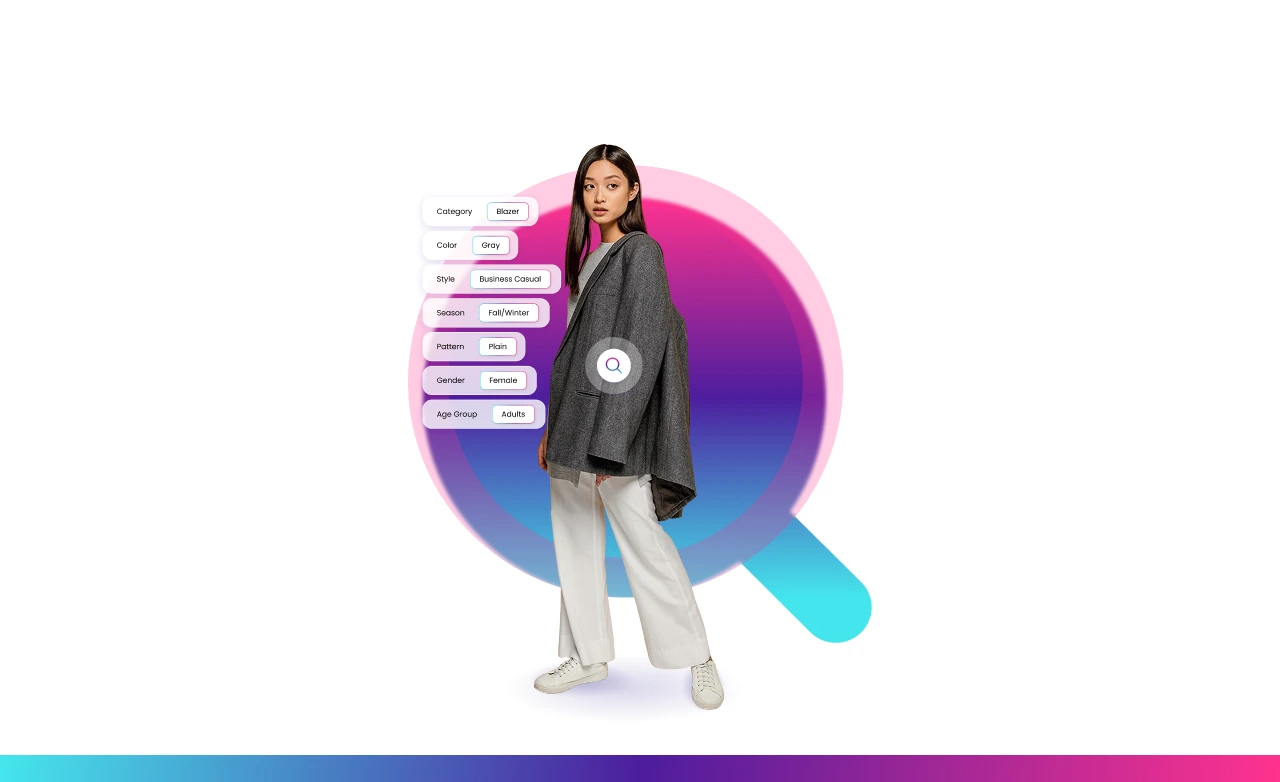
A modern fashion AI platform may identify that an image contains a women's midi dress. It may determine that the dominant color is navy, recognise a floral pattern, detect short sleeves, identify a V-neck construction, estimate a relaxed silhouette, and infer likely material characteristics.
Each observation becomes a structured data point. Taken together, these signals form a comprehensive representation of the product.
This transformation from visual information into structured intelligence is the foundation of fashion attribute extraction.
From Images to Structured Product Data Intelligence
The goal of fashion AI is not simply to recognise products.
The goal is to create machine-readable understanding.
This distinction is important.
Recognising that an image contains a jacket is useful. Understanding that it is a women's oversized single-breasted wool blazer with peak lapels, long sleeves, and a tailored silhouette is far more valuable.
Structured product data intelligence creates a shared language that downstream systems can use consistently.
Search engines can retrieve products more accurately. Filters become more precise. Recommendation systems gain richer contextual understanding. Content generation systems can create descriptions and titles automatically. Accessibility workflows can generate meaningful alt-text. Marketplaces can normalise data from thousands of sellers.
Every downstream capability becomes stronger when the underlying product data intelligence improves.
This is why attribute extraction is becoming such a critical layer in modern eCommerce architecture.
It sits beneath discovery, merchandising, content creation, personalisation, and increasingly AI-powered shopping experiences.
The Technology Behind Fashion Attribute Extraction
The latest generation of fashion AI combines several technological advances.
Computer vision models identify visual structures within product imagery. These systems learn to recognise garment categories, colors, patterns, textures, and design details through exposure to large volumes of training data.
Vision Transformers have further expanded what AI can understand. Unlike earlier image recognition systems that focused on local visual features, transformers help models understand relationships across an entire image. This allows them to interpret complex garments, layered outfits, and subtle design characteristics more effectively.
Multimodal AI represents another major breakthrough.
These systems connect visual understanding with language. Rather than simply identifying objects, they learn relationships between images and textual concepts. A model can learn that a particular visual style corresponds to descriptions such as "minimalist tailoring," "quiet luxury," or "contemporary streetwear."
This creates a bridge between how products look and how consumers search.
As a result, AI can increasingly understand not only what a product is, but also how people describe it.
Why Fashion Is One of the Hardest AI Problems
Fashion is significantly more complex than many traditional computer vision domains.
A chair is usually recognisable as a chair regardless of style variations. Fashion products operate differently.
Small visual differences can completely change how a garment should be categorised. The distinction between relaxed fit and oversized fit may be subtle. Similar fabrics can appear nearly identical in photography. Colours shift depending on lighting conditions, image editing, and material properties.
Fashion is also deeply influenced by culture and trends.
New aesthetics emerge constantly. Consumer language evolves rapidly. Social media introduces new terminology that may not have existed months earlier.
An AI system trained solely on generic image datasets will struggle to keep pace with these dynamics. This is why fashion-specific expertise matters.
Fashion AI requires specialised taxonomies, domain knowledge, and extensive training on fashion-focused datasets. Without these foundations, attribute extraction becomes inconsistent and unreliable.
The challenge is not simply recognising products. The challenge is understanding fashion.
Why Fashion Needs a Product Data Intelligence Layer
Most ecommerce technology stacks were not designed for this future.
PIMs, PLMs, ecommerce platforms, and marketplace systems serve important roles, but they primarily function as systems of record. They store, govern, and distribute information.
They do not typically generate deep product understanding.
This creates a gap.
Retailers need a dedicated intelligence layer capable of transforming raw product inputs into structured, reusable product knowledge.
This is the category Pixyle AI is building.
Visual Product Data Intelligence sits between product imagery and downstream commerce systems. It transforms images and existing inputs into machine-readable product understanding that can be reused throughout the organization.
Rather than replacing existing systems, it enhances them.
Search platforms become more accurate. Product content becomes richer. Accessibility initiatives become easier to scale. Marketplaces become more consistent. AI-driven discovery becomes more effective.
The value of the intelligence layer compounds across the entire commerce ecosystem.
The Future: Agentic Commerce and Machine-Readable Catalogs
The long-term direction of commerce is becoming increasingly clear.
AI systems will play a larger role in discovery, evaluation, comparison, and purchasing decisions. Autonomous shopping agents will rely on structured product intelligence to navigate catalogs and identify relevant products.
For retailers, this means machine-readability will become a competitive requirement.
Products that are clearly understood by machines will have greater visibility. Products with fragmented, incomplete, or inconsistent data will become increasingly difficult to surface.
The retailers that invest in structured product intelligence today will be better positioned for the next generation of commerce. The shift may appear technical, but its impact is fundamentally commercial.
Visibility, discoverability, and conversion will increasingly depend on how effectively machines can understand products.
Conclusion
Fashion eCommerce is moving toward a future where discovery is increasingly powered by AI.
In this environment, product data is no longer a back-office concern. It becomes a strategic asset that determines how products are discovered, recommended, compared, and purchased.
Fashion attribute extraction is a critical step in this transformation. By converting product imagery into structured, machine-readable intelligence, AI enables retailers to create richer catalogs, improve discovery, automate content creation, and prepare for emerging AI-driven commerce experiences.
The companies that succeed in the next era of retail will not necessarily be those with the most products.
They will be the companies whose products are easiest for machines to understand.
That is why visual product data intelligence is becoming a foundational layer of modern fashion commerce.
And that is why the future of product discovery starts with structured product understanding.
Discover Pixyle Ultimate Dress type Taxonomy Guide
Learn how to structure your catalog in a way that matches how people actually shop.


Boost your sales with AI product tagging
Optimize your eCommerce catalog to improve discovery and conversions.
.webp)