close icon

Answer Every Shopper Question - Automatically. On Every Product Page.

Pixyle AI generates product-specific FAQs for each item in your fashion catalog complete with FAQ schema markup that makes every product page eligible for Google AI Overviews, ChatGPT citations, and rich results.

Trusted by leading fashion commerce brands
Auto-generate product-specific FAQs | Pixyle AI
10+ hrs

Saved every month on manual FAQ writing and catalog updates.

70%

Fewer shopper questions, reducing uncertainty and support tickets.

2x

Higher AI search visibility and discovery in LLM-generated answers.

One solution. Three massive business outcomes. How product-specific FAQs transform your PDP performance.

FAQ builders built for fashion products

Existing FAQ tools produce the same generic store questions for every product on your site. A shopper looking at a cashmere turtleneck needs answers about that turtleneck - not a link to your returns page. Generic tools don't read your products, but Pixyle AI does.

FAQ schema = AI citation eligibility for every product

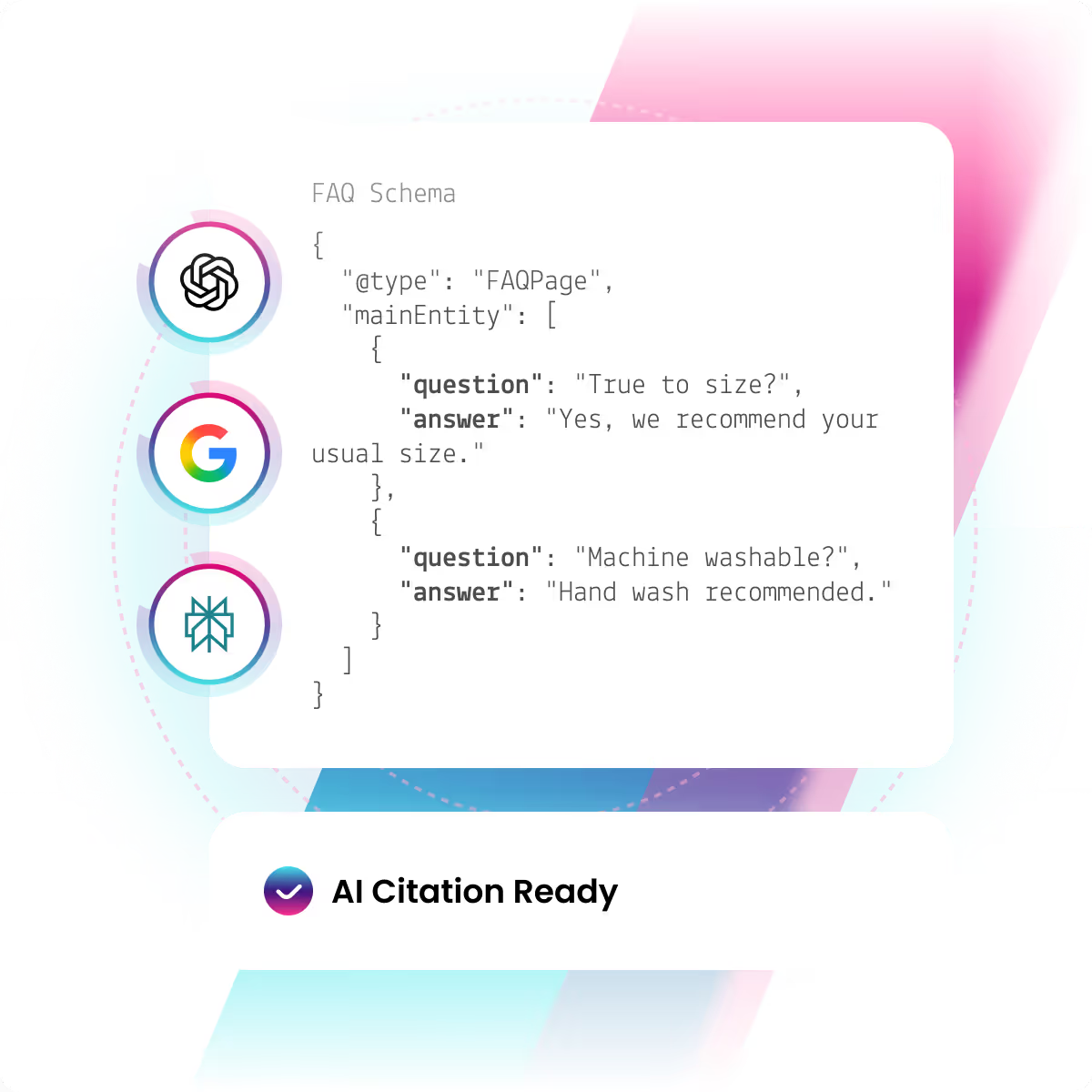
FAQ schema on every PDP makes your product pages eligible to be cited by AI systems. Your products become the authoritative answers for Google AI Overviews, ChatGPT Shopping, and Perplexity.

Higher PDP conversions, fewer repetitive tickets

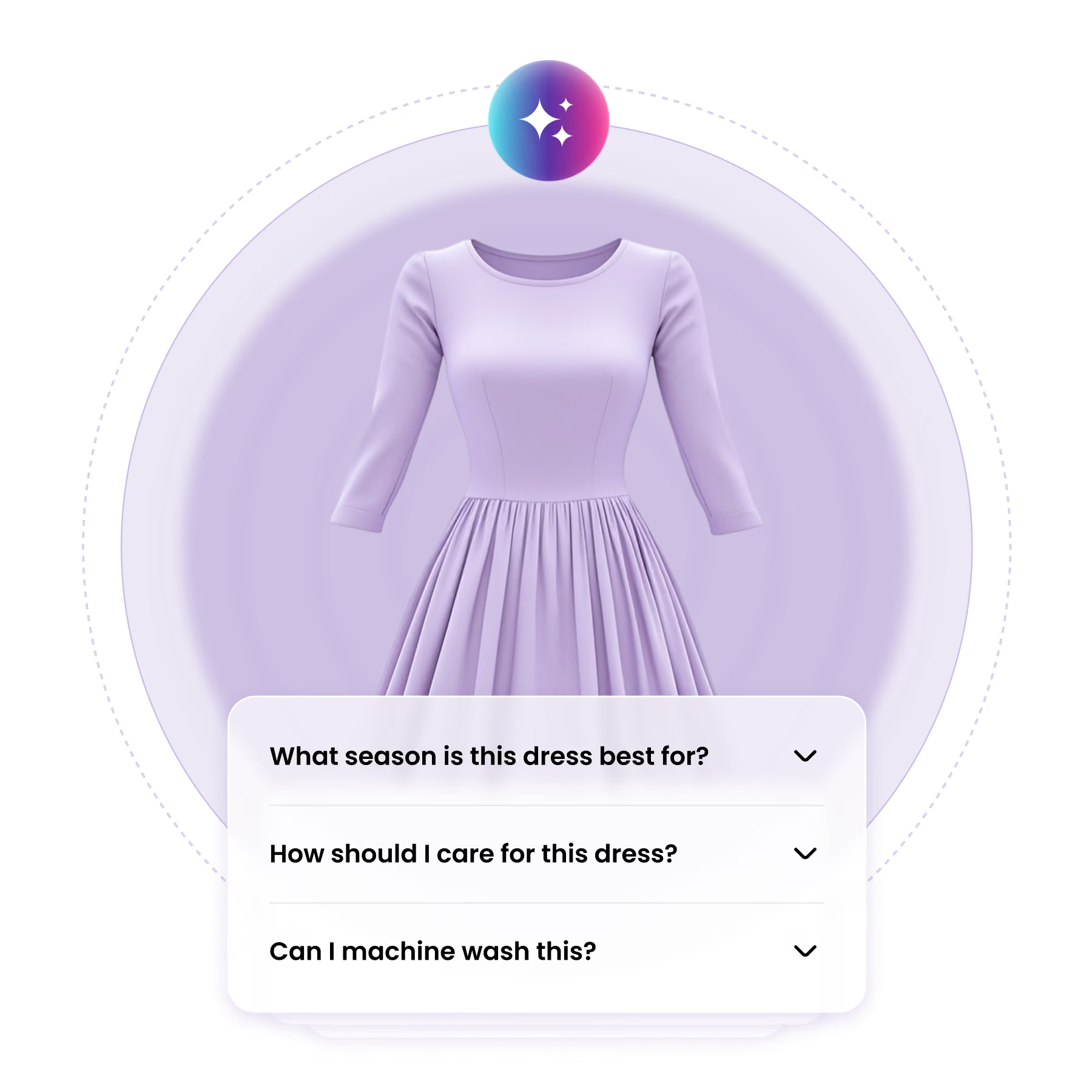
Product-specific FAQs resolve purchase anxiety directly on the page, driving higher conversion rates. By answering size, material, and care questions at the point of purchase, Pixyle AI eliminates the content gaps that typically overload your support queue.

The Impact of Product FAQ Automation

Time
Specificity
Schema Markup
Maintenance
Fashion Accuracy
Manual/Generic Tools
Speed
Requires 6–18 months of copywriter time to cover 10,000 products.
Consistency
Identical, store-wide template questions for every single product page.
Completeness
Requires manual coding, schema taggers, or separate development resources.
Completeness
Static text that rarely updates when product details or seasons change.
Completeness
Generic retail filler language that lacks precise garment construction details.
Pixyle AI Product FAQs
Speed
Ready in minutes and fully deployed across your catalog in days.
Consistency
100% unique Q&A sets automatically tailored to each individual SKU.
Completeness
JSON-LD schema markup is auto-generated alongside every Q&A set.
Completeness
Automatic FAQ regeneration whenever underlying product data changes.
Completeness
Fashion-native terminology that is completely attribute-accurate.

From product attributes to product-specific FAQs automatically

Pixyle AI reads each product individually. Every FAQ set it generates is unique to that product - not copied from a template, not recycled from another SKU.

01

Target Individual SKUs

Pixyle AI reads each product individually to generate unique, template-free FAQs for every SKU.

02

Ingest Product Signals

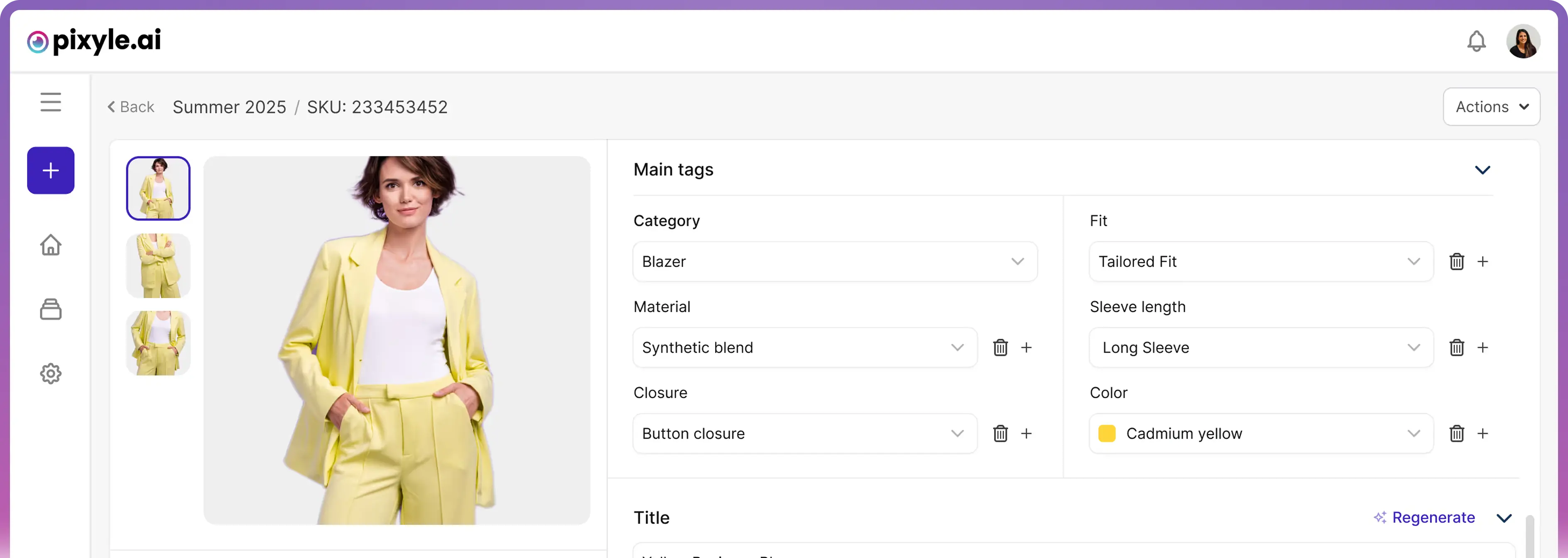
Ingests images, attributes, care labels, and metadata for true per-SKU understanding - zero category-level guessing.

03

AI generates the questions shoppers actually ask

Generates tailored Q&As based on specific item attributes, blending shopper intent with real product data.

04

Deploy Accordion & Schema

Delivers a clean, collapsible accordion display while embedding structured data for instant rich results and AI citations.

What’s Included: Complete Fashion Product FAQ Generation

From garment construction to fabric behavior. The output reads like a personalized shopping assistant who deeply understands your catalog.

Fit Dynamics

Maps precise garment geometry (e.g., true-to-size rules, hemline drops, neckline cuts, waist silhouettes) to eliminate shopper hesitation.

Material & Care Intelligence

Translates technical textile properties (e.g., blends, knit textures) and manufacturing signals (wash cycles, shrinkage) into clear, proactive product answers.

Functional & Structural Context

Extracts functional details and construction elements (e.g., pocket placements, closure types, lining specs) to answer specific situational queries.

Occasion & Styling Guidance

Automatically identifies the perfect setting for each item (e.g., office-appropriate, evening wear, casual weekend) helping shoppers confidently visualize the product in their wardrobe.

Product FAQs is part of Pixyle AI's Discovery Engine Suite

Frequently Asked Questions

Get quick answers about our Pixyle AI-driven solutions for ecommerce and fashion product attribution.

What are AI-generated product FAQs and how do they differ from generic FAQ tools?

AI-generated product FAQs are Q&A sets created automatically by AI for each individual product in your catalog — based on that specific product's attributes, images, and metadata. This is fundamentally different from generic FAQ tools, which produce the same template questions for every product on your site. Pixyle AI reads each product individually and generates questions relevant only to that item — with accurate answers drawn from the product's own data. The result is a unique FAQ set for every SKU, at catalog scale, without manual copywriting.

How does Pixyle AI generate FAQs that are specific to each product?

Pixyle AI ingests each product's full data set — images, attributes, material composition, care instructions, size information, and descriptive metadata — and uses AI trained specifically on fashion to generate questions shoppers are likely to ask about that specific item, paired with accurate answers derived from the product's own data. The AI understands fashion context: it knows what questions arise for a linen garment versus a leather one, for a structured piece versus a draped one. Every question generated is answerable by that product's information — Pixyle AI does not fabricate answers or apply generic copy.

Do Pixyle-generated FAQs include FAQ schema markup for rich results?

Yes. FAQ schema markup in JSON-LD format is generated automatically alongside every FAQ set — it is part of the output, not a separate step. Every product page published with Pixyle AI FAQs is immediately eligible for FAQ rich results in Google Search and structured to be cited by Google AI Overviews, ChatGPT Shopping, and Perplexity. FAQ schema is applied across your entire catalog — every product, automatically, without manual tagging per page.

Can I review and edit FAQs before they appear on product pages?

Yes. All Pixyle-generated FAQs go through your review workflow before publishing. You can approve, edit individual questions or answers, adjust tone to match your brand voice, or flag items for regeneration. Bulk approval workflows are available for high-volume catalogs. Pixyle AI also supports automatic regeneration when underlying product data changes — ensuring FAQs stay current as products are updated, without requiring manual re-review of items that haven't changed.

How many FAQs does Pixyle AI generate per product?

Pixyle AI generates between 4 and 8 FAQs per product by default, calibrated to the richness of the product's available data. Products with detailed attribute data — material composition, care specifics, construction details, fit information — naturally generate more relevant questions. The count is configurable: you can set minimum or maximum FAQ counts per category or product type. Every FAQ generated is relevant to that specific product — Pixyle AI does not pad the set with generic questions to meet a count target.

Does Pixyle AI support FAQ generation in multiple languages?

Yes. Pixyle AI supports multi-language FAQ generation for fashion retailers operating across multiple markets. FAQs are generated natively in each target language — not machine-translated from a primary language — preserving fashion-specific terminology, natural phrasing, and local nuance. Product pages in French, German, Italian, Dutch, Spanish, and other supported languages carry fully localised, accurate FAQ content and FAQ schema markup — ensuring consistent AI citation eligibility across all market versions of your catalog.

Make your fashion catalog AI-citation ready. Start with FAQs.

Join fashion retailers using Pixyle AI to generate product-specific FAQs at catalog scale — reducing cart abandonment, cutting support tickets, and making every PDP eligible for AI search citations.