How Product Data Quality Impacts Revenue: From Search to Discovery to Conversion

.webp)
For eCommerce teams, product data quality is often treated as a catalog or data-management issue. Product information needs to be complete, consistent and accurate before it can be published, but the impact of that work goes much further than keeping a PIM organised.
Product data sits upstream of many of the experiences that shape eCommerce performance. It helps determine how products are searched, filtered, compared, understood and discovered. When important information is missing or inconsistent, the effect can reach the customer experience, even when the products themselves are available in the catalog. This makes product data quality more than an operational metric. It can become part of the chain connecting product information to search, discovery, engagement and conversion.
The important question is not simply whether a retailer has product data. It is whether that data gives eCommerce systems and shoppers enough useful information to understand the products being sold.
Why Product Data Quality Is a Revenue Issue
Product data is often owned by teams responsible for PIM, catalog management, merchandising or product operations. Those teams focus on making sure products have the right information before they reach the storefront. But the same information is also used by search, filters, category pages, product listings, marketplaces and increasingly AI-powered discovery experiences.
A missing attribute is therefore not simply a missing field. If a product does not have a reliable colour value, it may be harder to surface when a shopper searches for that colour. If material information is missing, the product may not appear when a shopper uses a material filter. If category or taxonomy information is inconsistent, systems may have less context for determining where a product belongs.
The commercial impact should not be assumed in every individual case. A missing field does not automatically mean a lost sale. But incomplete or inconsistent information can introduce friction into the discovery journey. That is why product data quality should be considered alongside the experiences that depend on it.
How Product Data Affects Search and Discovery
Online shoppers rarely think about product data in terms of fields and taxonomies. They think in terms of what they want to find.
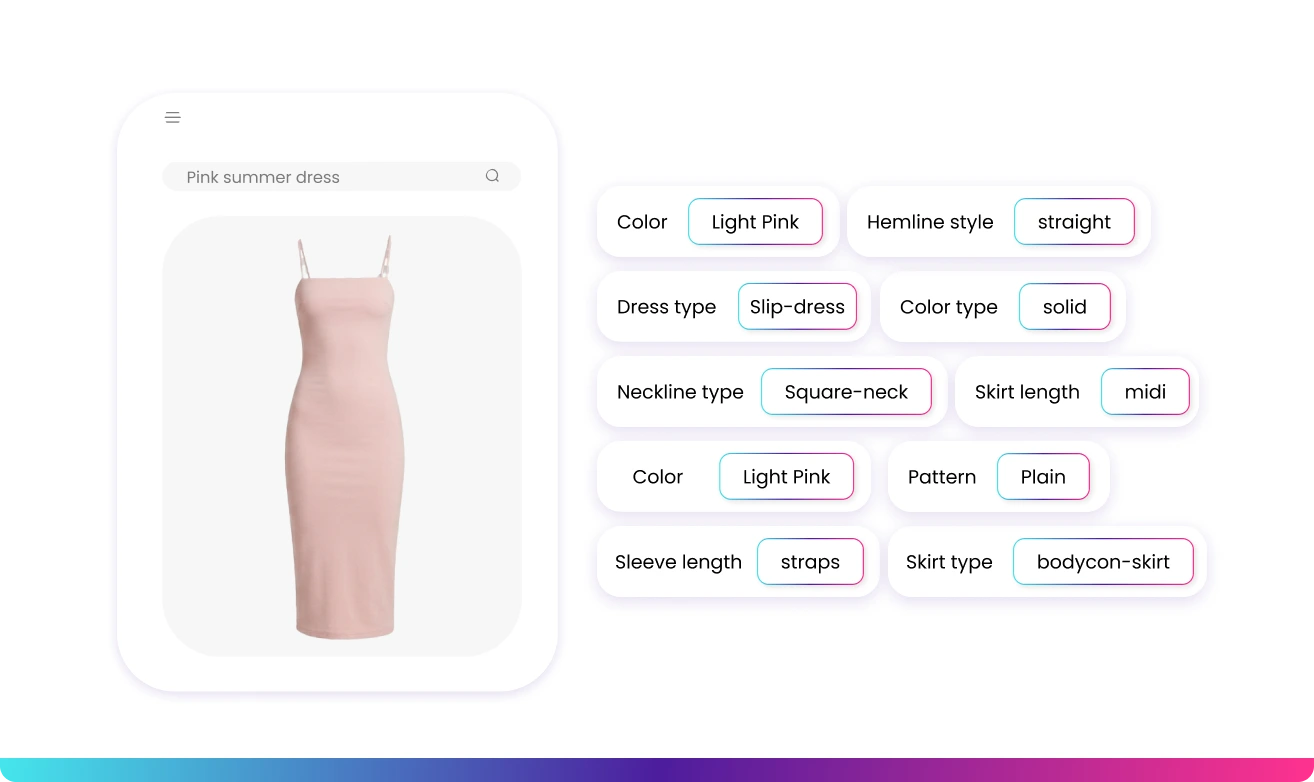
A shopper may search for a specific colour, material, silhouette or product characteristic. To return relevant results, an ecommerce search experience needs enough product information to understand those characteristics and connect them with the shopper's intent. Those characteristics can exist in different parts of a product record. Some may be included in a title or description. Others may be stored as structured product attributes. Some may only be visible in the product image. This is where product attributes become commercially relevant.
A product may technically be in the catalog, but that does not necessarily mean it is easy to discover for every relevant search or filtering experience. Product data can also become inconsistent across large catalogs. Information may arrive from different suppliers, with different terminology and different levels of detail. Internal teams may use different conventions across collections. Some attributes may be entered manually while others are generated from source content.
One source might describe a colour as "navy", another as "dark blue", while another might simply use "blue". One supplier might provide a detailed material composition, while another only provides a broad category such as "fabric". The individual differences may seem small, but they become more significant when they are repeated across thousands of products. A search system or filter can only work with the information available to it. It cannot reliably use an attribute that has not been provided, identified or standardised.
This means product discoverability depends partly on how well the underlying product information represents what the product actually is.
From Discovery to Conversion
Discovery is only one stage of the customer journey. Before a shopper can purchase a product, they need to encounter it, understand it and consider it relevant to their needs. Product data can influence several of these stages.
It can help determine whether a product matches a search query, whether it appears under a relevant filter and whether shoppers have the characteristics they need to compare products.
A shopper who cannot find relevant products has fewer opportunities to evaluate them. A shopper who finds a product but cannot easily understand its characteristics may also have less information available when deciding whether it meets their needs. This creates a useful framework for thinking about the commercial role of product data:
Product data quality → search relevance → product discovery → product engagement → conversion → revenue
The purpose of this chain is not to suggest that every improvement automatically moves every metric. Pricing, assortment, merchandising, UX, brand, availability and many other factors influence eCommerce performance. Instead, it provides a framework for identifying where product data may contribute to commercial performance.
Measuring the ROI of Product Data Improvement
One of the biggest mistakes retailers can make is measuring product data improvement by how much information has been added to the catalog. Adding thousands of attributes shows operational output, but not necessarily business impact. A stronger approach is to connect data quality with measurable performance. Teams can track attribute coverage, completeness, consistency and taxonomy accuracy, alongside search click-through rate, zero-result searches, filter engagement and product views. Commercial metrics such as add-to-cart rate, conversion rate, revenue per session and average order value can then provide further context.
The goal is not to attribute every commercial change to product data, but to identify whether improvements in data quality are associated with measurable changes in ecommerce performance.
Where AI Product Enrichment Fits
For large fashion catalogs, maintaining product data quality manually can become difficult to scale.
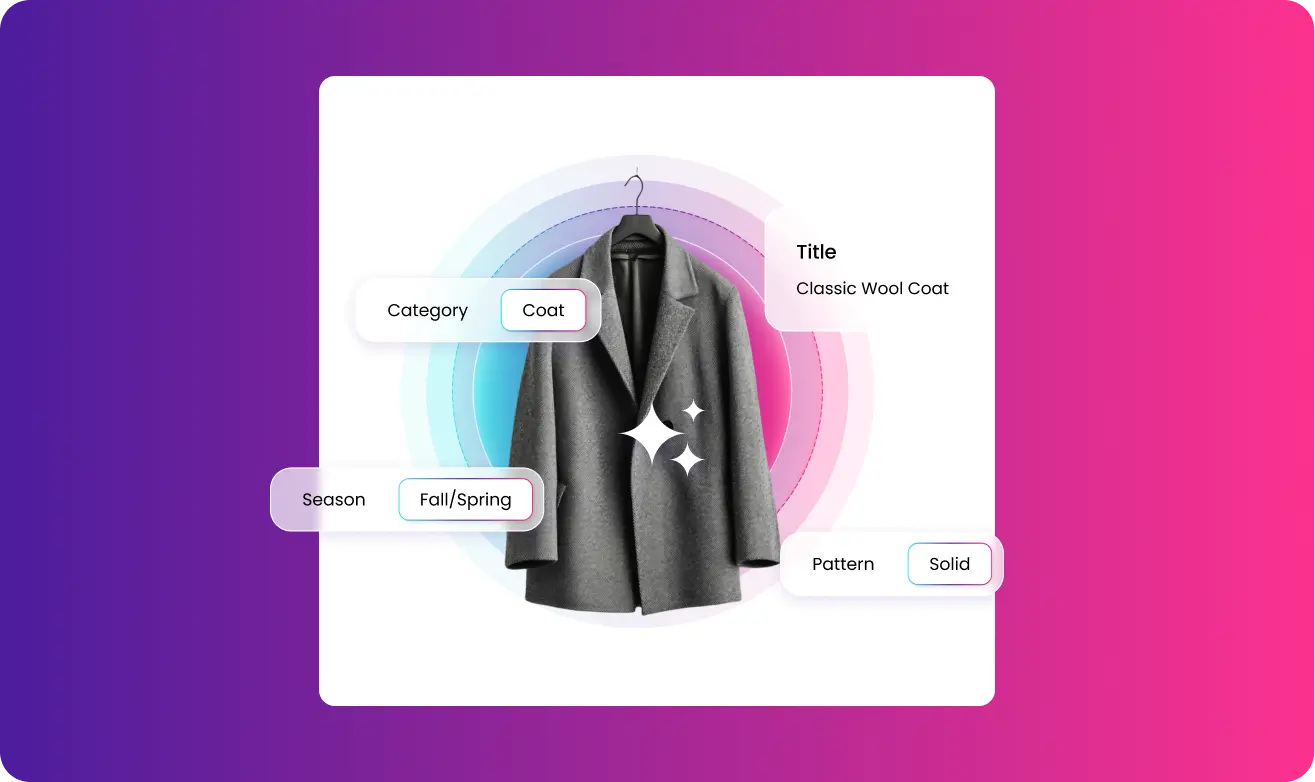
Product information can come from suppliers, merchandising teams, legacy systems, product photography and other sources. The information available for one product may therefore differ significantly from the information available for another. AI product enrichment can help automate parts of this process. AI can analyse product images to identify visual characteristics, identify missing attributes, standardise terminology, map information to a retailer's taxonomy and enrich existing product records. It can also support the automation of repetitive catalog processes that would otherwise require manual review.
For fashion, this is particularly relevant because product imagery can contain information that may not exist elsewhere in the product record.
An image can provide signals about colour, pattern, silhouette, neckline, sleeve type, fit, material appearance and other characteristics. Turning those visual signals into structured product information can help connect the image asset to the data systems that power eCommerce experiences. The important distinction is that AI product enrichment should not be evaluated only by how many attributes it can generate.
The value isn't the number of attributes generated. The value is what those attributes enable downstream.
If enriched information improves the consistency of a catalog, it can give search and filtering systems more useful context. If it improves product discoverability, retailers can then investigate whether that change is reflected in engagement and commercial metrics. AI therefore becomes part of the product data workflow rather than the business outcome itself.
Product Data in an AI-Driven Discovery Environment
The role of product data is also expanding beyond traditional eCommerce search. AI-powered search and discovery experiences increasingly need detailed information about products in order to understand what they are, how they differ and which products may be relevant to a particular request.
A shopper may not interact with a traditional category page or filter system at all. They may describe what they want in natural language and expect an AI-powered experience to identify suitable products.
That makes product information increasingly important as machine-readable input. The same principle applies here as it does with traditional search. If important product characteristics are missing, inconsistent or difficult to interpret, the system has less information to work with.
This does not mean that structured product data guarantees visibility in AI search. AI-powered discovery depends on many factors, including the systems being used, the quality and availability of information, technical implementation and the broader digital presence of a retailer. But it does reinforce the importance of treating product data as an active part of the discovery infrastructure.
The Business Case for Better Product Data
Product data is not valuable simply because it is complete. It is valuable because better product information can make products easier for systems and shoppers to understand and discover.
For eCommerce teams, that means moving beyond the question of whether a catalog contains enough information.
The more useful questions are:
- Can shoppers find the products that match their intent?
- Can search and filtering systems distinguish between relevant and irrelevant products?
- Can merchandising and ecommerce teams measure where discovery is working and where it is creating friction?
- Can improvements in product data be connected to measurable changes further down the customer journey?
This is where product data quality becomes a business issue rather than only a data-management issue.
The journey is not simply:
Data → Revenue
It is:
Data quality → Search relevance → Discovery → Engagement → Conversion → Revenue
Each stage provides an opportunity to measure what is changing and why.
For retailers managing large and complex catalogs, the objective is not to create more data for its own sake. It is to create product information that is accurate, consistent, useful and available to the systems responsible for helping shoppers find and understand products.
That is the real business case for product data quality.
Better product information creates a stronger foundation for the search, discovery and eCommerce experiences that contribute to it.
Discover Pixyle Ultimate Dress type Taxonomy Guide
Learn how to structure your catalog in a way that matches how people actually shop.


Boost your sales with AI product tagging
Optimize your eCommerce catalog to improve discovery and conversions.
Related posts
Stay updated with our latest blog posts.