PIM vs Pixyle AI Product Data Intelligence: What's the Difference?


For years, Product Information Management (PIM) has been at the center of how retailers organize and manage product information.
A PIM gives teams one place to manage product data, maintain product attributes, support workflows, and distribute information across ecommerce channels. For retailers with large and complex catalogs, it has become an important part of the technology stack. But product data is changing.
Retailers are working with more suppliers, more product variations, more channels, and increasingly sophisticated search and discovery experiences. At the same time, AI systems are changing how shoppers find and evaluate products. This creates a new challenge.
Having a system to manage product information is no longer enough. Retailers also need to make sure that the information entering and moving through that system is complete, consistent, accurate, and understandable.
This is where Product Data Intelligence comes in. So, what is the difference between PIM and Product Data Intelligence?
A PIM manages product information. Product Data Intelligence uses AI and automation to understand, enrich, standardize, and improve that information.
The two are not competing technologies. In many cases, they work best together.
What Does a PIM Do?
A Product Information Management system is designed to centralize and manage product information. Instead of keeping product details across spreadsheets, supplier files, ecommerce platforms, and different internal systems, retailers can use a PIM as a central environment for managing product information.
It can help teams organize product attributes, descriptions, categories, specifications, and other information associated with a product. It can also support workflows, approvals, governance, localization, and distribution to different channels. This makes the PIM an important part of the product data infrastructure.
But there is a distinction between managing information and understanding information. A PIM can store a product as “blue.” It can store another product as “navy.” It can store “relaxed fit” for one product and “loose fit” for another. The PIM can manage those values. What it does not necessarily do is determine whether those different terms should be standardized, identify information that is missing, or infer product characteristics from an image. That is a different problem. And as product catalogs become larger and more complex, that problem becomes increasingly difficult to solve manually.
What Is Product Data Intelligence?
Product Data Intelligence is the use of AI and automation to understand, enrich, standardize, and improve product information so it can be used consistently across ecommerce systems and digital channels.
The key difference is the word understand. Product Data Intelligence is not simply about storing information or moving it from one system to another. It is about interpreting product inputs and turning them into information that is more useful for commerce.
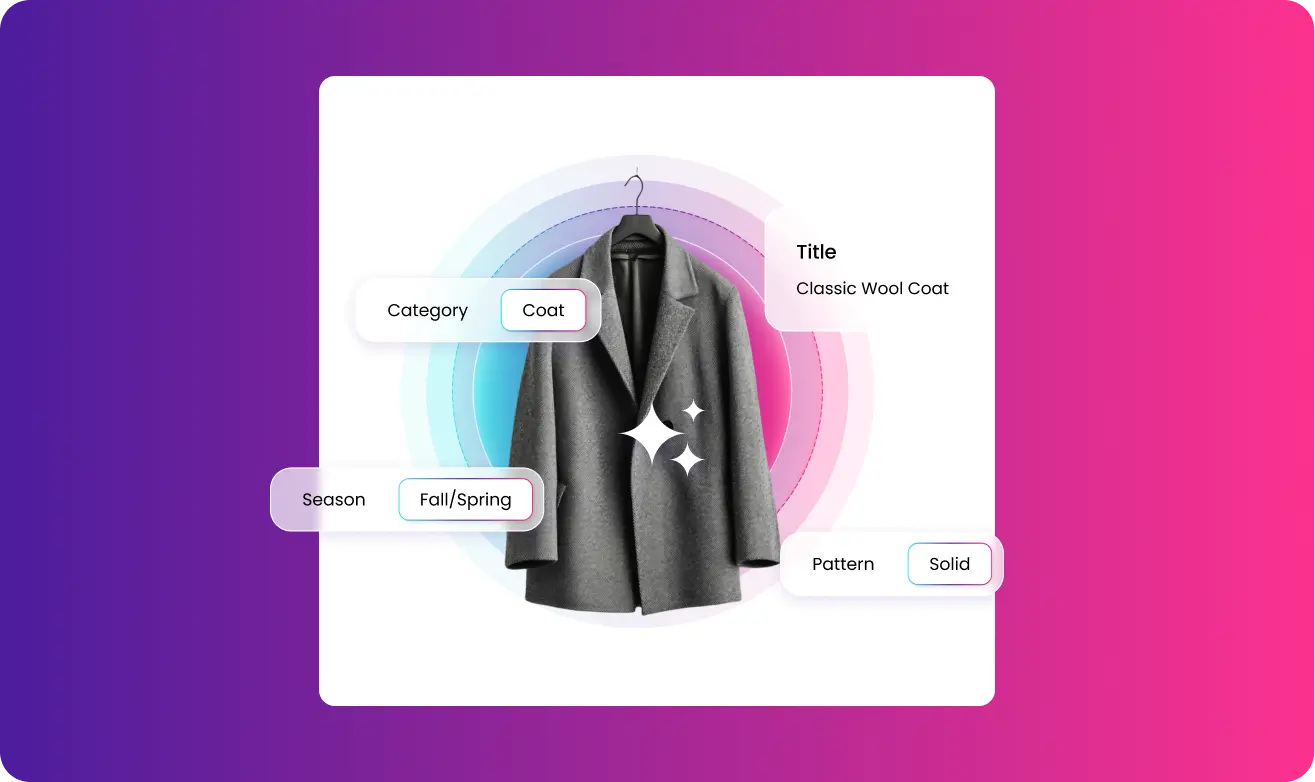
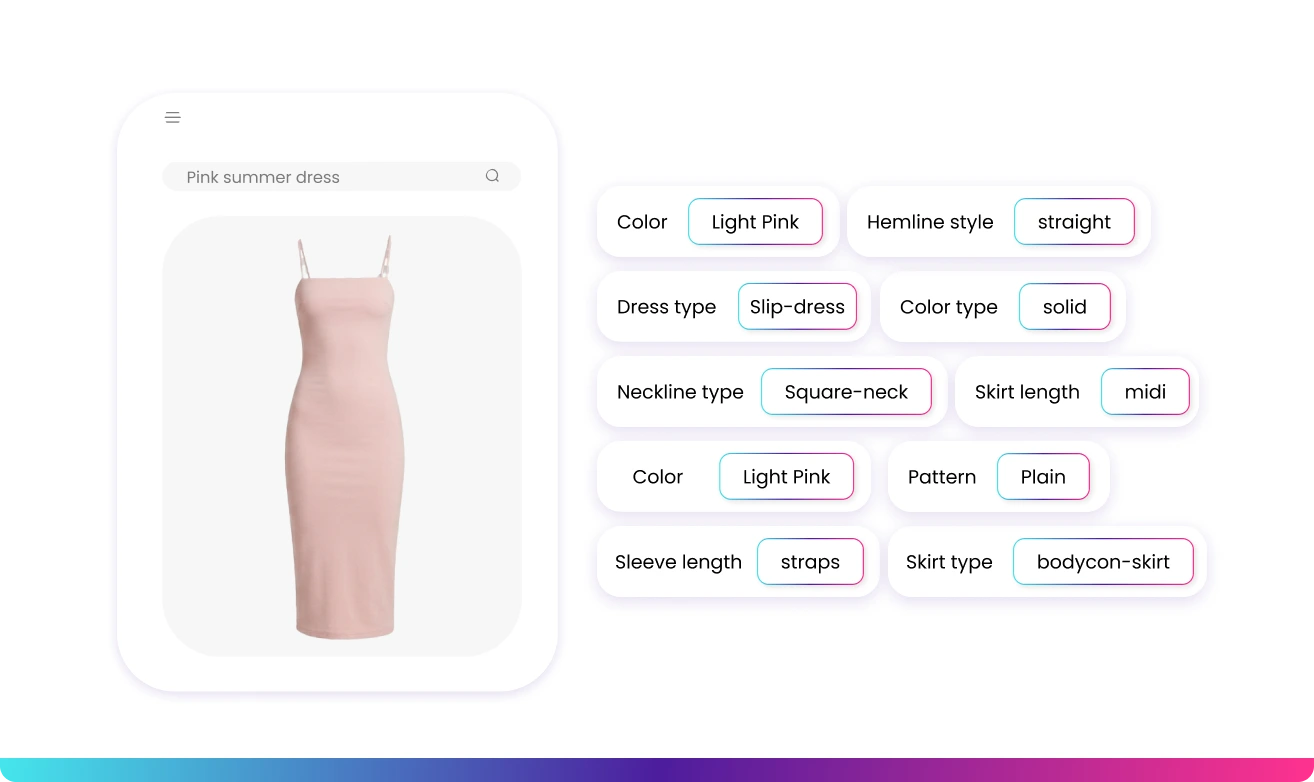
For fashion retailers, much of the information needed to understand a product can be found in the product image itself. A supplier might provide a product feed with a title and a few basic attributes. The image, however, may reveal that the product has a floral pattern, a V-neckline, long sleeves, a fitted silhouette, or a particular material appearance. That information can be extracted and turned into structured product attributes. The same principle applies to existing product data. If one supplier uses “midnight blue,” another uses “navy,” and another uses “dark blue,” Product Data Intelligence can help recognise the relationship between those terms and map them to the retailer's preferred product data model. This is what makes Product Data Intelligence different from simply adding more content. It is about creating a better understanding of the product itself.
PIM vs Product Data Intelligence: The Difference
The easiest way to think about PIM vs Product Data Intelligence is to look at where each sits in the product data lifecycle.
A PIM is primarily responsible for managing product information. Product Data Intelligence is focused on improving the information before and while it is being used. A PIM answers questions such as: Where is the product information stored? Who can edit it? What is the approved value? Which channels should receive it?
Product Data Intelligence answers a different set of questions: What information is missing? What does this product actually contain? Are different suppliers describing the same characteristic in different ways? What additional attributes can be identified from the product image? How can this information be made more consistent and useful?
That difference is important. The PIM provides control over product information. Product Data Intelligence adds intelligence to that information. This is why the comparison should not necessarily be framed as PIM vs Product Data Intelligence. For many retailers, the more useful model is PIM + Product Data Intelligence.
Why PIM Alone Can Fall Short
A PIM can be an effective system for managing product information while the information itself remains incomplete.
This is one of the biggest challenges facing retailers with large or multi-brand catalogs. Every supplier has its own way of describing products. One brand may describe a jacket as “cropped,” while another uses “short.” One may call a color “stone,” another “beige.” Some suppliers may provide detailed information about fabric and fit, while others provide almost nothing beyond a product name and price. These differences are manageable when a catalog is small. At scale, they become a product data quality problem.
The retailer needs the information to work as one catalog, even though it comes from many different sources.
A PIM can provide the structure for managing that information, but the work of interpreting, enriching, and standardising inconsistent inputs may still require significant manual effort. The same applies when information is simply missing. A product image may clearly show that a garment has a certain neckline, pattern, sleeve length, or silhouette. But if those characteristics are not included in the supplier feed, the PIM has no information to manage.
Someone has to identify them. Traditionally, that someone has been a merchandising, content, or catalog operations team. As product volumes increase, this approach becomes difficult to scale.
Where AI Product Enrichment Fits
This is where AI product enrichment becomes valuable.
Instead of relying entirely on people to manually review every product, AI can analyze product inputs and identify relevant information at scale.
For example, a retailer may receive a product with a basic title, a short supplier description, and a product image. The source data may tell the retailer that it is a dress. Visual AI can potentially identify additional characteristics from the image, while AI can also work with the existing text and attributes to create a more complete product understanding. That information can then be standardized according to the retailer's own taxonomy and product data model. The result is not simply a longer product record. It is a product record that contains more meaningful information about the product. This distinction matters because product data automation should not be about automating the creation of more fields for the sake of having more fields. The goal is to automate the work required to make product information more accurate, consistent, and useful.
Product Data Intelligence Is Not a Replacement for PIM
For retailers that have already invested in a PIM, the idea of adding another technology can raise an obvious question:
Do we really need another layer?
In many cases, the answer is yes, but not because the PIM is no longer useful. The PIM and Product Data Intelligence have different roles. The PIM can remain the central system for managing product information, workflows, governance, and distribution. Product Data Intelligence can work alongside it to improve the quality and completeness of the information being managed. This creates a broader product data architecture. Product images and supplier information can first be analyzed and enriched through an intelligence layer. The resulting information can then flow into the PIM, where it can be managed and governed before being distributed to eCommerce platforms, search systems, marketplaces, and other channels. The purpose is not to replace the systems retailers already rely on.
It is to make the information flowing through those systems more useful. That distinction is especially important for enterprise retailers, where replacing core systems is expensive, disruptive, and rarely necessary. The better question is not whether a retailer should replace its PIM. The better question is whether the existing product data can be made more intelligent.
Why Product Data Quality Matters More Than Ever
The importance of product data is closely connected to the way products are discovered. In traditional eCommerce, shoppers might navigate through categories, apply filters, or enter keywords into a site search bar. Those experiences depend on product information. If a product does not have the right category, color, fit, material, or other relevant attributes, it may not appear when a shopper filters or searches for it. The same principle is becoming even more important as discovery becomes more AI-driven. A shopper might search for something like “a relaxed-fit linen shirt in neutral colors for a summer holiday.”
That query is not simply looking for the word “shirt.” It expresses an understanding of product type, fit, material, color, and use case. For an AI system to identify relevant products, those concepts need to exist somewhere in the underlying product information. This is why structured product data is becoming increasingly important. AI systems need to understand products in terms of their characteristics and relationships, not simply recognise that a product page exists. The richer and more consistent the underlying information is, the more opportunities there are for that information to support search, filtering, recommendations, AI discovery, and other digital experiences.
Product Data Intelligence and AI-Ready Commerce
The shift toward AI-driven commerce changes the role of product data. Search engines, AI assistants, recommendation systems, and emerging shopping agents increasingly need to interpret product information in context. They need to understand what a product is, what it looks like, what it is made from, how it fits, what style it represents, and how it relates to a shopper's intent. This creates a different requirement for product information.
It is no longer enough for the data to exist somewhere in the retailer's systems. It needs to be understandable and usable by the systems responsible for discovery. This is where Product Data Intelligence can become an important part of an AI-ready commerce strategy. By using AI to understand product images and existing information, retailers can create richer product data that can support multiple downstream applications. The same enriched information can contribute to eCommerce filters, onsite search, product descriptions, SEO, marketplaces, AI search, and other discovery experiences. Instead of creating separate information for every new channel, retailers can strengthen the underlying product understanding and allow that information to work across the ecosystem.
From Product Information Management to Product Data Intelligence
PIM solved an important problem for eCommerce: product information needed a central place to be managed. But centralising information does not automatically make that information complete or consistent. That is the problem Product Data Intelligence addresses. It introduces a layer of understanding between the raw inputs a retailer receives and the product information that eventually gets distributed. This can be particularly valuable for fashion because fashion products are highly visual and contain a large number of attributes that influence how shoppers search and make decisions.
A product is not simply a dress, a shirt, or a pair of shoes. It has a particular color, material, silhouette, fit, pattern, style, occasion, and many other characteristics. Those characteristics may be visible in an image without being explicitly represented in the source data. Product Data Intelligence helps turn that visual and contextual information into structured product data that can be used by the rest of the commerce stack.
PIM + Product Data Intelligence: Building a Stronger Product Data Foundation
The future of product data management is not necessarily about choosing one system over another. It is about giving each system the role it is best equipped to perform. The PIM can remain responsible for managing product information and providing the operational foundation for product data workflows. Product Data Intelligence can provide the intelligence needed to understand, enrich, standardise, and improve that information. Together, they create a more complete approach to product data.
The relationship can be simple:
Product Data Intelligence helps create and improve the information. PIM helps manage it. Other commerce systems use it.
That model allows retailers to strengthen their existing technology stack without having to start over.
The Bottom Line
The question is not whether PIM or Product Data Intelligence is more important. They solve different problems. A PIM provides a place to manage product information. Product Data Intelligence helps retailers understand and improve that information using AI and automation. For retailers dealing with complex catalogs, inconsistent supplier data, missing attributes, and increasingly AI-driven discovery, that distinction matters. The next generation of ecommerce will depend on systems that can understand products, not simply store them. That means product information needs to become more than something that is managed.
It needs to become something that is understood, enriched, standardised, and ready to be used wherever products are discovered. PIM gives retailers control over their product information. Product Data Intelligence helps make that information intelligent.
And together, they provide a stronger foundation for the next generation of ecommerce.
Discover Pixyle Ultimate Dress type Taxonomy Guide
Learn how to structure your catalog in a way that matches how people actually shop.


Boost your sales with AI product tagging
Optimize your eCommerce catalog to improve discovery and conversions.
.webp)