AI Shopping Is Here. Is Your Fashion Catalog Ready?


Why Machine-Readable Product Data Is Becoming Essential for Fashion Ecommerce
For years, fashion retailers have focused on optimising their eCommerce experiences for human shoppers. Beautiful product photography. Inspiring descriptions. Intuitive navigation. Fast checkout. These remain essential. But they're no longer the only audience your product catalog needs to serve. Today, a growing number of purchase journeys begin somewhere entirely different. Instead of typing keywords into a search engine, shoppers are asking AI assistants questions like:
"I'm looking for a black linen blazer for summer weddings." "Show me waterproof hiking jackets suitable for autumn in Scotland." "Recommend sustainable denim brands similar to Levi's."
Rather than displaying hundreds of products, AI-powered shopping experiences increasingly deliver a curated selection based on context, preferences, and product understanding. This represents one of the biggest shifts in eCommerce since online search. The question for fashion retailers is no longer whether AI will influence shopping. It's whether their product data is ready for AI to understand it.
Search Is Evolving Into Conversation
Traditional eCommerce search has always relied heavily on keywords. Customers searched for "blue dress." Retailers optimised product titles, descriptions, and metadata to match those searches. Today's AI-powered experiences work differently. Large language models don't simply match keywords. They interpret intent.
Instead of searching for "white trainers," shoppers might ask: "I'm travelling to Italy next month and need comfortable white sneakers that I can wear all day but still look stylish enough for dinner."
To answer accurately, AI needs far more than a product title.It needs structured information describing materials, colours, fit, silhouette, occasions, style categories, weather suitability, product features, and visual characteristics. Without this information, even the most advanced AI cannot confidently recommend the right products. The future of product discovery depends on the quality of the product data behind every catalog.
AI Doesn't Browse Your Website Like People Do
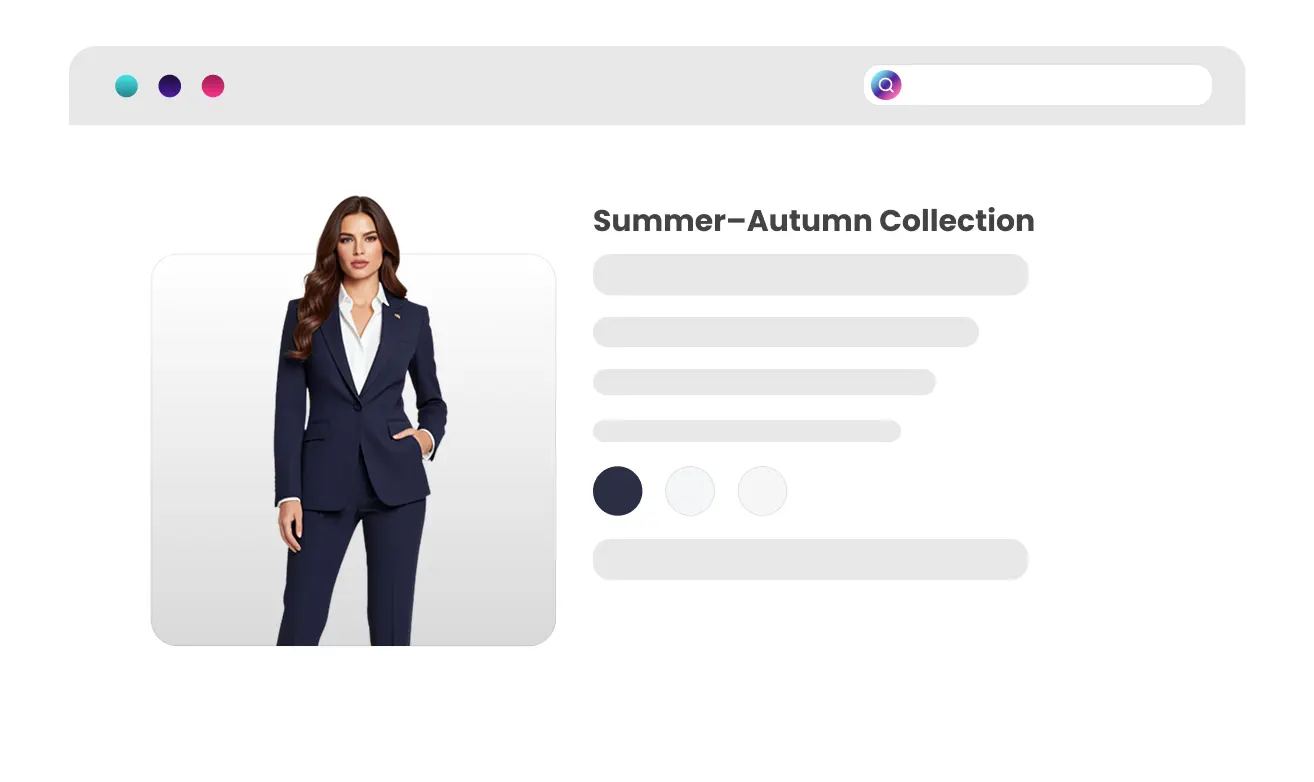
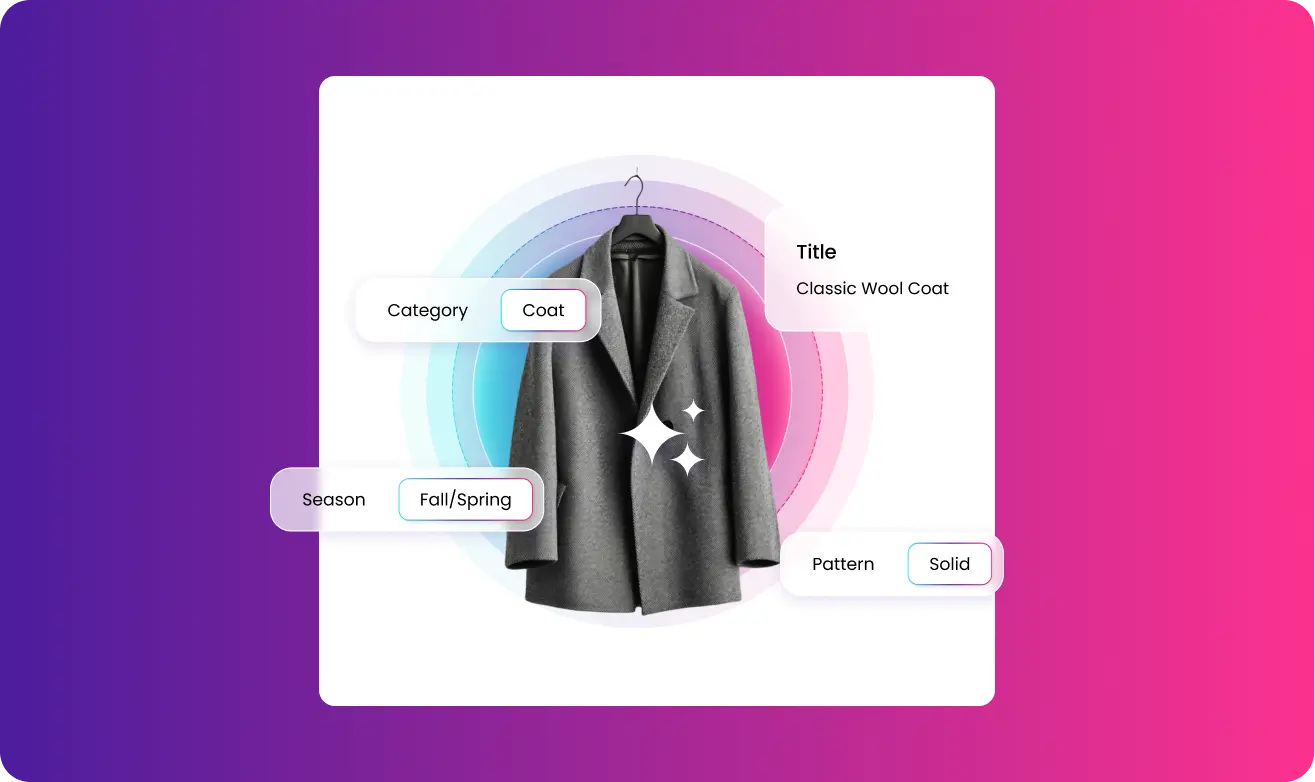
One of the biggest misconceptions surrounding AI commerce is that AI behaves like a human shopper. It doesn't. People can interpret a product image instantly, they recognise colours, understand silhouettes, notice textures, and compare styles almost without thinking. AI works differently. While computer vision has advanced significantly, it still relies heavily on structured information to understand products consistently and accurately. If your catalog simply contains a product name, brand, price, and two images, AI has limited context to work with. Compare that with a product enriched using structured attributes such as category, colour, material composition, pattern, fit, sleeve length, neckline, occasion, style classification, seasonality, care instructions, search tags, and AI-generated image metadata. Suddenly, AI has enough information to understand not just what the product is, but when, why, and for whom it is relevant. This is the difference between a catalog built for humans and one designed for both humans and machines.
What Does "Machine-Readable" Actually Mean?
Machine-readable product data isn't about making information more technical, it's about making it structured. Every important characteristic of a product becomes an explicit attribute rather than hidden inside a paragraph of descriptive text or visible only within an image. Instead of describing a dress as "an elegant flowing midi dress featuring delicate floral detailing," machine-readable product data identifies it in discrete terms: product category as dress, length as midi, pattern as floral, fit as regular, sleeve type as long sleeve, neckline as V-neck, occasion as occasionwear, season as spring/summer, and material as a viscose blend. This structured format allows eCommerce platforms, recommendation engines, search systems, marketplaces, and increasingly AI shopping assistants to interpret products consistently. For fashion retailers managing thousands, or even millions, of SKUs, structured data creates a common language across every digital channel.
Why Fashion Retail Needs Machine-Readable Product Data More Than Almost Any Other Industry
Fashion products are inherently visual. Unlike electronics or books, customers rarely search using exact specifications, they search using style, mood, occasion, fit, fabric, colour combinations, and current trends. This complexity creates enormous challenges for traditional product catalogs. Take a simple black dress: one shopper may search for a "minimalist office dress," another might ask for an "elegant dress for a winter wedding," and someone else might search for a "long sleeve black midi dress for dinner." These customers may all be looking at exactly the same product. The only way AI can recognise that relationship is through rich, structured product data. Without it, products become invisible to highly specific, intent-driven searches, and as conversational AI becomes more common, these searches will only become more detailed.
AI Shopping Agents Need Context, Not Guesswork
The next generation of eCommerce won't simply recommend products, it will help shoppers compare, narrow choices, explain differences, and even justify recommendations. To do that, AI needs context. If a customer asks which jacket is better for a rainy weekend in Amsterdam, the answer depends on information such as water resistance, insulation, fabric composition, weight, intended use, and seasonality. If those attributes don't exist within the catalog, AI has to guess, and guessing rarely creates a great shopping experience. Machine-readable product data replaces assumptions with confidence, enabling AI to deliver recommendations based on facts rather than incomplete information.
How Machine-Readable Product Data Improves SEO, GEO, and AI Discovery
For years, SEO has focused on helping search engines understand web pages. Today, that same principle applies to AI-powered discovery. Whether a customer uses Google Search, Google AI Overviews, ChatGPT, Perplexity, Claude, or the next generation of shopping assistants, one thing remains consistent: AI needs structured, reliable information. Product titles alone are no longer enough. Rich product attributes, standardized taxonomy, detailed descriptions, image metadata, product FAQs, and structured content all provide additional context that helps AI understand what makes a product relevant. This doesn't replace traditional SEO, it strengthens it. Machine-readable product data supports better indexing by search engines, more relevant product recommendations, improved onsite search accuracy, better filtering and navigation, and greater visibility in AI-powered shopping experiences. The more context your catalog provides, the more confidently AI can surface your products when customers are looking for exactly what you sell.
The Rise of Agentic Commerce
We're entering a new phase of eCommerce. Instead of simply browsing websites, shoppers are increasingly asking AI to help them research, compare, and recommend products. This shift is often referred to as Agentic Commerce, a model where AI acts as an intelligent shopping assistant rather than just a search tool. Preparing machine-readable product data for these experiences is a growing priority in Pixyle's content strategy. Imagine asking, "Find me a lightweight wool coat suitable for business travel that pairs well with formal outfits," or "Compare these three trainers and recommend the best one for walking all day." The AI isn't selecting products randomly, it's making decisions based on structured information. If your catalog lacks detailed product attributes, AI has fewer signals to work with. As a result, products may be overlooked, not because they aren't relevant, but because there isn't enough information for AI to understand and recommend them confidently. As AI shopping continues to evolve, product data becomes one of the most important foundations for visibility.
Product Data Intelligence Bridges the Gap
Many retailers already have thousands of product images. Most already have product titles. Many also have descriptions. What they're often missing is the structured intelligence that connects everything together. This is where Product Data Intelligence becomes essential. Rather than relying solely on manual enrichment, Product Data Intelligence helps transform visual product information into structured, reusable, machine-readable data that supports every downstream eCommerce process. That includes product attributes, taxonomy classification, search tags, product titles, product descriptions, image metadata, AI-generated ALT text, product FAQs, and marketplace-ready attributes. Instead of creating content separately for every channel, retailers build one structured source of truth that can power ecommerce websites, search engines, AI assistants, marketplaces, and future commerce experiences.
Five Signs Your Fashion Catalog Isn't Ready for AI
Many retailers assume their catalog is complete because every product has a title, description, and images. In reality, AI readiness depends on much more. Ask yourself whether product attributes are consistent across every category, whether two similar products can be compared using structured information, whether colours, materials, fits, and patterns are standardised, whether AI can distinguish between casual, formal, outdoor, or occasionwear products, and whether every product contains enough context to answer detailed customer questions. If the answer to several of these questions is "no," your catalog likely has opportunities for improvement. The good news is that these challenges are solvable.
Preparing Your Catalog for AI Commerce
Building an AI-ready catalog doesn't require starting from scratch. It begins with improving the quality and consistency of your product data. Fashion retailers should focus on standardizing product attributes across categories, building a consistent taxonomy, enriching products with detailed, structured metadata, improving image descriptions and accessibility, generating consistent titles and descriptions, and maintaining a single source of product truth across every sales channel. These improvements don't only support AI, they also improve merchandising efficiency, product discovery, customer experience, and operational scalability.
The Future of Fashion Commerce Starts with Better Product Data
Every major shift in eCommerce has been driven by better information. First came search, then personalisation, then recommendations. Now AI is reshaping how customers discover products. But AI is only as effective as the information it can understand. Fashion retailers don't need to predict every new AI model or every future shopping platform, they need to ensure their product data is ready for whatever comes next. Machine-readable product data isn't simply another technical requirement; it's becoming the foundation for discoverability, product intelligence, and AI-powered commerce. The retailers investing in that foundation today will be better positioned to compete tomorrow.
Discover Pixyle Ultimate Dress type Taxonomy Guide
Learn how to structure your catalog in a way that matches how people actually shop.


Boost your sales with AI product tagging
Optimize your eCommerce catalog to improve discovery and conversions.
.webp)